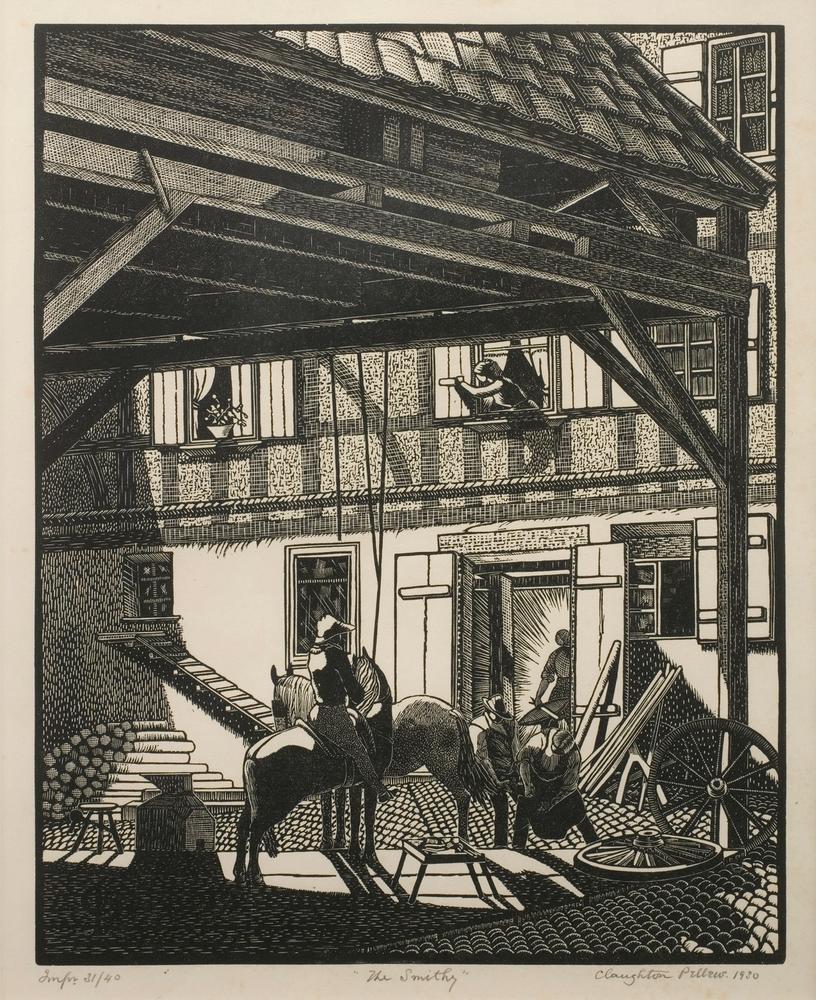
Claughton Pellew (1890 - 1966)
The Smithy, 1930
Wood engraving
25.3 x 20.2 cm
Signed and titled
From the edition of 40
It is hard to look at the work of Claughton Pellew without being reminded of Samuel Palmer. His old-fashioned imagery and sun-lit agricultural landscapes place him firmly within the neo-romantic tradition, evoking a pastoral age. In The Smithy (1930), men bend over a horseshoe as the sun beats down, whilst a woman cleans the blinds of a Tudor house – images that would appear closer to the work of artists such as Palmer and Bewick rather than it does with his contemporaries, including his good friend Paul Nash who he met at the Slade School of Art.
Having rejected the modern world it is unsurprising that Pellew’s artistic sympathies lay with the past. After the outbreak of the First World War, he found himself ostracised in his own country. With his conversion to Roman Catholicism, he became a conscientious objector and was subsequently interned. The sense of separation never left him. After the war, Pellew and his wife moved to a remote rural part of Norfolk, where they built their own home and lived for most of their lives.