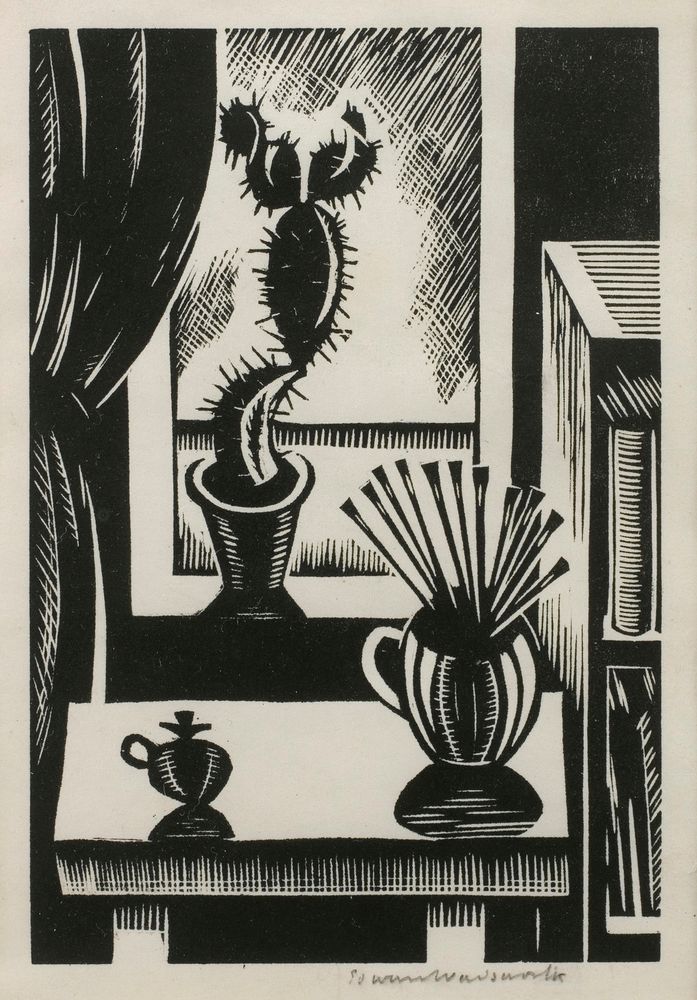
Edward Wadsworth (1889 - 1949)
Still Life, 1921
Woodcut
15.2 x 10.2 cm
Signed
From the edition of 30
No one was more important for the re-emergence of British woodcutting than Edward Wadsworth. His woodcuts of the 1910s redefined the medium and transformed the way it was viewed. It is therefore striking that he would choose to draw a line under this part of his career in the most visceral way possible by burning all of his original blocks in 1927. By then, it had been six years since he broke away from the printmaking that he had become synonymous with, persuing instead his new interest in Surrealism. The act of burning was almost petulant and suggested a man at odds with his own legacy.
Inspired by the German Expressionists - particularly Kandinsky, whose work he encountered during his time in Munich - few have matched Wadsworth's creativity with woodcutting. As the only printmaker amongst his Vorticist contemporaries, his stylised images, characterised by heavy black ink on stark white paper, were unlike anything else previously seen in Britain. His prints were produced in small editions, rarely signed or numbered and created for pure artistic exploration rather than commercial gain.
Still life (1921) holds an important place as Edward Wadsworth’s final woodcut. There is a subtle hint of the surreal about the spiked cactus, illuminated by light filtering through the window, whilst a jar of paint brushes stands prominently in the foreground. This signals his break from the constraints of the long-dispersed Vorticist movement, to become the painter he hoped to be. Yet the image is unmistakably Wadsworth: delicate hatching is interwoven with bold black lines, signalling that even as he moved on, he was still a master of his craft.